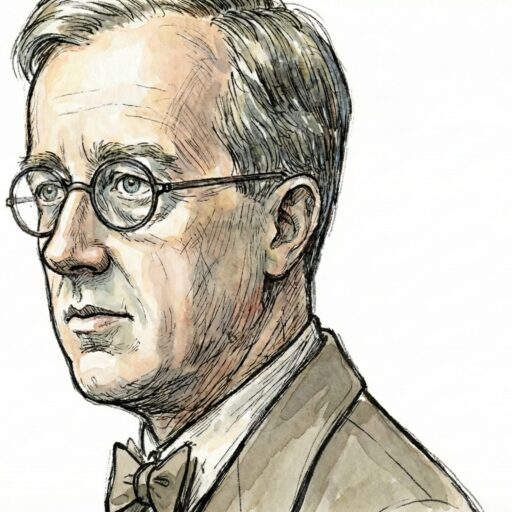

By 1917, Gustav Holst was arguably at the height of his creative powers, yet the world around him was fracturing. He had recently completed his massive orchestral suite, The Planets, but World War I was raging. Holst tried to enlist but was rejected due to his poor eyesight, neuritis, and digestion. Consequently, he spent this period teaching at St Paul’s Girls’ School and Thaxted, feeling a sense of uselessness regarding the war effort until the YMCA eventually accepted him as a musical organizer for troops in the Near East in 1918 (Michael Short, Gustav Holst: The Man and His Music, p. 126).
It was against this backdrop of global catastrophe, specifically the slaughter of the Battle of the Somme, that Holst turned his mind toward a text that dealt not with conventional comfort, but with mystical transcendence. Raymond Head argues that the work is Holst’s “philosophical response to the War; to suffering so intense… that it was scarcely comprehensible” (Raymond Head, Tempo, p. 25).
The primary influence here is G.R.S. Mead, a scholar of Gnostic and Sanskrit texts and a friend of Holst. Mead introduced Holst to the “Apocryphal Acts of St. John,” a second-century Gnostic text containing a hymn supposedly sung by Jesus and the disciples before the Crucifixion (Head, Tempo, p. 25). At a time when English choral music was often “ponderously pious,” Holst offered something archaic, ecstatic, and startlingly new. Ralph Vaughan Williams noted that the work “shows his modernity equally whether he is straining our harmonic sense to breaking point… or writing a simple broad melody” (Vaughan Williams, Music & Letters, p. 182).
Holst intended to depict a religious experience that was mystical rather than dogmatic. The reception was overwhelmingly positive, solidifying Holst’s reputation before The Planets had a full premiere.
Inside the Music The work is divided into a Prelude and the Hymn proper. The Prelude opens with the plainchant Vexilla Regis played on trombones, a sound Holst knew intimately from his own days as a trombone player. This is followed by one of the most striking moments in 20th-century choral music: while the orchestra plays independent oscillating chords, the treble semi-chorus sings the plainchant in the distance. Raymond Head describes this as creating “a sensation of distance in time as well as space” (Head, Tempo, p. 26).
The work was first performed on March 25, 1920, at the Queen’s Hall, conducted by the composer. It was a sensation. Ralph Vaughan Williams was so moved by the performance that he reportedly said he “wanted to get up and embrace everyone and then get drunk” (Head, Tempo, p. 25).
Critics and peers alike hailed it as a masterpiece. The musicologist Donald Tovey wrote: “It completely bowls me over. If anybody doesn’t like it, he doesn’t like life” (Short, p. 187). It quickly became a staple of the choral repertoire, helping to convince the public that an English composer could write music that was both technically adventurous and spiritually profound.
This piece is really for the listener who wants to be transported. It is not “comforting” religious music; it is intense, mystical, and occasionally strange. I was personally struck when I heard the moments of spoken text, the rhythms, and the vibrancy of the piece. It appeals to those who love the ethereal textures of Neptune but want to hear that same cosmic mystery applied to the human voice.
”I have no home, in all I am dwelling. I have no resting place. I have the earth…”
Bibliography
- Capell, Richard. “Gustav Holst.” Music & Letters 7, no. 4 (1926): 310–21.
- Gibbs, Alan. Holst Among Friends. London: Thames Publishing, 2000.
- Head, Raymond. “The Hymn of Jesus: Holst’s Gnostic Exploration of Time and Space.” Tempo (July 1999).
- Holst, Imogen. The Music of Gustav Holst. 3rd ed. Holst’s Music Reconsidered. Oxford: Oxford University Press, 1986.
- Short, Michael. Gustav Holst: The Man and His Music. Oxford: Oxford University Press, 1990.
- Vaughan Williams, Ralph. “Gustav Holst (Continued).” Music & Letters 1, no. 4 (1920): 305–17.