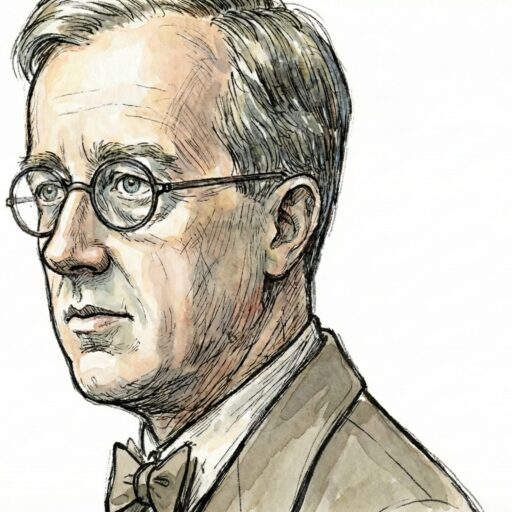

To understand The Planets, one must first reconcile the duality of its creator. Gustav Holst was a man of paradoxes: a schoolmaster who was also a visionary; a professional trombone player who became a devotee of Sanskrit literature; and a composer who sought to bridge the gap between the “unnatural” world of high modernism and the practical needs of amateur musicians.
While the public often views this suite through the lens of astronomy, its genesis was entirely astrological and psychological. During the 1910s, Holst was in his 40s and navigating a period of professional uncertainty. His early opera Sita had failed to win the Ricordi prize, and his most recent large scale work, The Cloud Messenger, had premiered to indifferent reception.
In March 1913, a gift from an anonymous benefactor allowed Holst to travel to Spain with Clifford Bax (brother of another composer, Arnold Bax). It was Clifford, an astrologer, who introduced Holst to the study of horoscopes. Holst became fascinated by Alan Leo’s book, What is a Horoscope? (later retitled The Art of Synthesis), which described the character profiles of each planet. Holst found these descriptions so compelling that he used them as the psychological framework for a new orchestral suite.
Musically, The Planets marked a radical departure for a British composer. Although he was very rooted in the English folk-song revival (like his contemporaries Ralph Vaughan Williams and Cecil Sharp), Holst was also keenly aware of the shockwaves of European modernism. Shortly before commencing work, he had attended London performances of Schoenberg’s Five Orchestral Pieces and Stravinsky’s The Rite of Spring. These influences emboldened Holst to strip away the Wagnerian chromaticism of his youth (seen in early works like Sita) in favor of bitonality, massive orchestral textures, and asymmetrical rhythms.
Did you know: Holst originally called this piece Seven Pieces for Large Orchestra.
Compositional Struggles
The creation of this massive score was a physical triumph over pain. Holst suffered from severe neuritis in his right arm, which made holding a pen for long periods agonizing. He composed much of the work in the sound-proof room at St Paul’s Girls’ School, sketching on two pianos. He relied on a devoted team of scribes in former pupils and colleagues, most notably Vally Lasker, Nora Day, and Jane Joseph. They helped write out the full orchestral score from his sketches. This collaborative physical process belies the singular, autocratic vision of the music itself.
A Tour of the Suite
Holst described the work as a “progression of life,” a series of mood pictures moving from physical struggle to spiritual release.
1. Mars, the Bringer of War
This is not heroic warfare; it is a mechanized, inhuman force. Holst utilizes a relentless 5/4 ostinato to create an unbalanced, driving momentum. The use of col legno strings (striking the string with the wood of the bow) creates a skeletal and percussive sound, while the bitonal clash of G major against D-flat major generates an unresolvable tension. It is a common misconception that “Mars” was written as a reaction to World War I. In reality, Holst had completed the sketch for the movement before the declaration of war in August 1914.
2. Venus, the Bringer of Peace
Serving as a structural foil to “Mars,” “Venus” offers a sense of cool serenity rather than romantic warmth. Through crystalline orchestration featuring the celesta and flutes, Holst presents peace not just as the absence of war, but as a state of psychic relief.
3. Mercury, the Winged Messenger
This scherzo acts as a bridge between worlds. It is a study utilizing rapid cross-rhythms and bitonality (B-flat against E) to depict the swiftness of thought.
4. Jupiter, the Bringer of Jollity
In the most popular of the movements, Holst celebrates the prime of physical life. This movement contains the suite’s most famous melody, a ceremonial theme later adapted into the hymn “I Vow to Thee, My Country.” Ironically, Holst considered this tune a “happy accident” and felt it didn’t quite fit the movement’s overall exuberance.
5. Saturn, the Bringer of Old Age
Recorded as Holst’s personal favorite, “Saturn” depicts the slow, inevitable march of time resembling the tolling of bells. The movement transforms the terror of decay into a serene acceptance of wisdom. It sounds the most like the mature style Holst would explore in his later years.
6. Uranus, the Magician
A heavy-footed dance which features a terrifying climax where the magician seems to lose control of his spell, culminating in a sudden, shocking silence that prepares the ear for the finale.
7. Neptune, the Mystic
Holst saves his most experimental writing for the end. There are no themes in the traditional sense, only fragments of melody floating over a static harmonic background (reminiscent of Debussy). In a pioneering acoustic effect, Holst placed a female choir in an adjacent room, instructing the choir to slowly walk away from their seats and out of the hall to simulate sound disappearing into infinity. I think this is one of the first “fade-outs” in orchestral history.
Reception and Legacy
The Planets was first performed in a private concert in 1918, conducted by Adrian Boult, as a gift from Holst’s friend Henry Balfour Gardiner. The first complete public performance followed in 1920 under Albert Coates.
The work quickly became a massive popular success, a fact that eventually distressed the composer. Holst was a man who shrank from public acclaim; he famously hated the “lionization” that followed and would hand people who asked for his autograph a typed card stating that he did not give them out. He felt the suite’s popularity overshadowed his more austere, mature works like Egdon Heath.
In a final irony, the work that Holst claimed led him to “swear off” his belief in astrology (though he continued to cast horoscopes for friends until the end of his life) became the very piece that immortalized his name. While The Planets seemed to have brought him the least joy in his final years, it remains a singular achievement in 20th-century music.