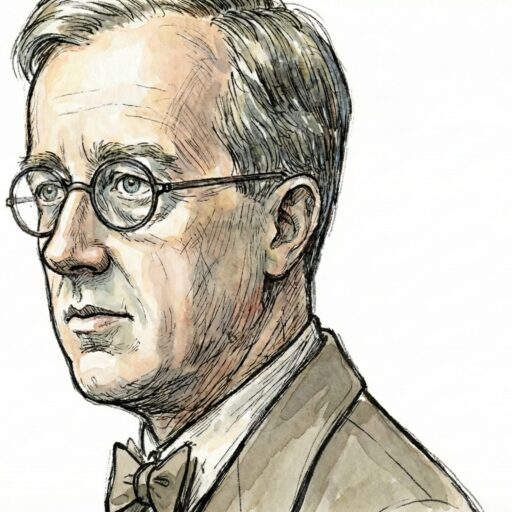
Gustav Holst was born on 21 September 1874 in Cheltenham, England, the first of two children born to Adolph and Clara von Holst.
Adolph was an accomplished pianist who taught students and practiced for many hours during the day, often to the neglect of his wife, Clara, and their two children. Adolph’s family was of Swedish origin; one of his ancestors had served as a court composer in Russia until he fell out of favor and was exiled to Germany. Soon afterwards, the family emigrated to England. Holst’s mother, Clara, was a piano student of Adolph’s when they first met. Clara’s great-great-grandmother was from Spain, where she had been an actress before marrying an Irishman and moving to Ireland. Clara was sweet, gentle, and unassuming, but her constitution was not strong. She died soon after the birth of her second child, Emil, when Gustav was only eight.
Adolph’s sister, Nina, was brought in to look after the children, but unfortunately she, too, was distracted by the piano. In her youth, Nina had famously spread petals in the path of Franz Liszt.
Gustav was an oversensitive and somewhat miserable child. His eyes were weak, though no one realized he needed spectacles. His chest was also weak, and again, his asthma went largely untreated, forcing him to rest while climbing stairs. In his youth, Gustav hated practicing the violin but enjoyed the piano, which he had begun to practice as soon as his fingers could reach the keyboard.
In 1885, Adolph married another of his students, Mary Thorley Stone, and Gustav was sent to Cheltenham Grammar School. His father was determined to make young Gustav a virtuoso pianist, but even in his youth, Holst was troubled by neuritis in his hands. This made long hours of practice a severe strain. As he grew older, Gustav tried his hand at composition, but initially failed to gain scholarships to the Royal College of Music or other various colleges in London.
Holst obtained his first professional engagement in 1893, serving as organist at Wick Rissington, a small Cotswold village. Soon afterwards, he also became organist and choirmaster of the choral society at Bourton-on-the-Water. These early experiences helped the young composer grow in his understanding of the inner workings of a choir. Choral music and the English choral tradition would remain vital throughout the rest of Holst’s life.
Inspired by the music of Arthur Sullivan, Holst composed a two-act operetta in 1892 called Lansdown Castle, which was produced at the Cheltenham Corn Exchange the following year. Although the music could not escape the influence of Sullivan, the performance was a great success with critics and the audience alike. Adolph was sufficiently impressed to borrow money to send Gustav to the Royal College of Music under regular admission.
At the College, Holst studied composition with Charles Villiers Stanford. Although he often disagreed with Stanford’s opinions, Holst was always grateful to him, especially for teaching him how to become his own critic.
A year before attending the Royal College of Music, Gustav heard Richard Wagner’s Götterdämmerung conducted by Gustav Mahler at Covent Garden. He was overwhelmed by the lush sonorities. Reinforced by the friendship of a fellow student at the College, Fritz Hart, Gustav became an ardent Wagner enthusiast. Once, after hearing Tristan und Isoldefrom the gallery, he walked all night through the streets of London with his mind in a whirl.
Another overwhelming experience was hearing the Bach Mass in B Minor at the Three Choirs Festival in Worcester in 1893. He was so taken aback by the choruses that he felt as if he were floating above the crowds. It was one of the few memorable musical events in his young life thus far. However, the cramping neuritis in his right hand was perpetually defeating him as a keyboardist. Prolonged practice became impossible, and he was forced to realize that he could not maintain his technique any longer.
Holst therefore decided to take up the trombone. It would allow him to play in orchestras and provide him with an income. Furthermore, the experience would be useful to him as a composer. Perhaps he also thought that playing the trombone would help to strengthen his chest and lungs.
As a student, Gustav Holst was frugal. He never smoked nor drank, and since leaving home, he had become a strict vegetarian. However, vegetarianism was not encouraged in his cheap lodgings in the 1890s. Since he was never given a completely nourishing meal, his eyes became very weak and his hand remained in constant pain. Yet despite these physical problems and his extremely shy and solitary nature, he was already showing an absorbing interest in other people. He hated conventionality and rejoiced in ideas he found fantastic or humorous. He enjoyed a good laugh.