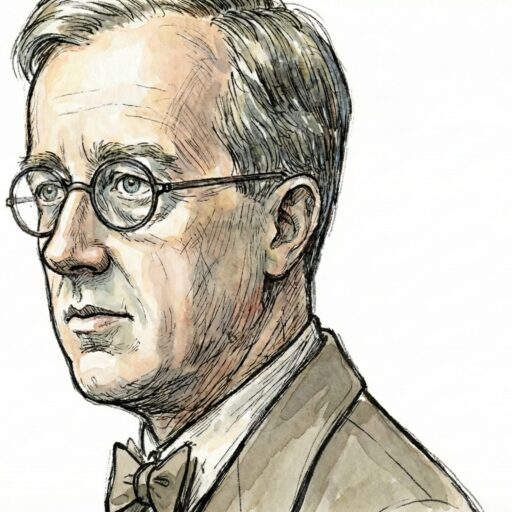
After Gustav Holst’s death, there came the inevitable decline in performances. But The Planets had, of course, secured his international reputation. And largely due to the untiring work of his daughter, Imogen Holst, and the enterprise of a number of enthusiasts and record companies like Lyrita, Chandos, and Hyperion, modern audiences have been able to assess his larger legacy of music. His contribution to the development of musical education in schools and adult education is also widely acknowledged.
Despite his initial training at the Royal College of Music, Holst was largely self-taught as a composer, learning by experience and pondering deeply on his art. He avoided preconceived systems and academic theory. He went his own way, experimenting, constantly searching for the right notes. Sometimes he was successful; at other times he wasn’t. He refused the safe, easy answer.
Holst was impervious to whims and fashion. Although he was naturally delighted with success, he was wary of it, and he was not put off by failure. “If nobody likes your work, you have to go on for the sake of the work,” he said. “And you’re in no danger of letting the public make you repeat yourself.” Holst’s personality was a remarkable combination of opposing characteristics. He was friendly, gregarious, jolly, and rumbustious, but he was also solitary, aloof, and remote. He was perceptive and business-like, but he could also be quite naive in life and music. He was a practical realist, but he was also a dreamer and visionary. There was a strong logical clarity of expression with a capacity to create the most complex contrapuntal forms; and there was the irrational, romantic creativity. These contrasts in his personality are apparent in his music.
Gustav was not conventionally religious. He believed strongly in supra-human forces, and besides dabbling in astrology, he was much influenced by Eastern religious theory—particularly the doctrines of Dharma and reincarnation.
He believed that the duty of a composer is to fulfill practical needs, and if music were needed for his school classes, he did not hesitate to supply it. He could quite easily write mundane arrangements of Christmas carols or hymn tunes as well as major, so-called “serious” works without any sense of incongruity. Holst would devote as much time and care to a song for voice and violin as to a full-scale choral symphony.
Gustav Holst died at the tragically early age of 59. He seemed to be entering a new creative phase, and the old spontaneity and warmth was returning. Given the techniques he had been developing through the 1920s, one wonders what else he might have achieved.
Imogen Holst, of course, was a distinguished conductor, scholar, teacher, and composer in her own right. Her recordings of her father’s music have an irresistible sense of enthusiasm and an exhilarating rhythmic vivacity. From 1964, when she ceased working as Benjamin Britten’s assistant, until her death in 1984, most of her energies were devoted to promoting the wider knowledge and dissemination of her father’s music.
Credits
All Text by Ian Lace © 1995.
Ian Lace (d. 2021) was a freelance music reviewer and lecturer in England. He wrote regularly for the BBC Music Magazine, Classic CD, Fanfare, and the British Music Society News (in addition to various British music related websites). He was so gracious to provide these biographical notes for this website, and did the same for other major British composers such as Edward Elgar and Arnold Bax. The text was edited by Kenric Taylor with assistance from others.
Bibliography for Text and Images:
Holst, Imogen. Gustav Holst. Oxford: Oxford University Press, 1938, rev. 1969.
Holst, Imogen. A Scrapbook for the Holst Birthplace Museum. London: G and I Holst Ltd., 1978.
Short, Michael. Gustav Holst, The Man and His Music. Oxford: Oxford University Press, 1990.