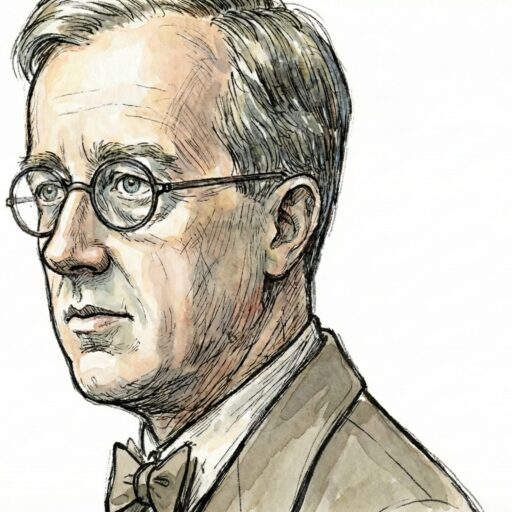

By 1913, Gustav Holst was arguably entering the most crucial transition of his creative life. Approaching his fortieth birthday, he was suffering from a growing sense of failure. His large-scale choral work The Cloud Messenger had received a disastrous premiere in March 1913, leaving him “distraught” and “fed up with music, especially my own.” To lift his spirits, his friend and benefactor H. Balfour Gardiner funded a holiday to Spain and Mallorca for Holst and his friends Clifford and Arnold Bax. It was during this trip that Holst was introduced to astrology, the spark that would eventually ignite The Planets. Amidst this personal crisis and creative pivot, Holst composed the Hymn to Dionysus.
From Sanskrit to Ancient Greece
While Holst is famous for his “Sanskrit” period, this work marks a shift toward Ancient Greece. The primary influence here is Euripides. Holst set a text from the Bacchae, translated by the eminent scholar Gilbert Murray. Interestingly, Ralph Vaughan Williams was simultaneously working on incidental music for the same text for a project with dancer Isadora Duncan that never materialized. It is likely Holst was introduced to the text through his friend.
Musically, the piece reflects Holst’s absorption of the European avant-garde. Having recently heard Stravinsky’s The Firebird and Petrushka and Schoenberg’s Five Orchestral Pieces in London, Holst began to experiment with a new sound world. The Hymn to Dionysus suggests he was also listening to Ravel, specifically Daphnis et Chloé, utilizing a more sensuous, “French” texture than his usual austere style.
The work is scored for female chorus and large orchestra. It acts as a bridge in his output. It looks back to the “oriental” harmonies of his earlier suite Beni Mora, but it also looks forward to the wild energy of his most famous work.
- The Opening: The piece begins with a deceptive serenity. A clarinet solo rises over a flute and string ostinato, creating a “dangerous tranquility” as the choir sings “Oh, blessèd he in all wise.”
- The Climax: As the Maenads (the female followers of Dionysus) cry “Up, O Bacchae,” the music transitions into a driving rhythm. The final rush for the mountains is massive and aggressive, clearly foreshadowing the “Martian drive” that would appear in The Planets just a few years later.
The Hymn to Dionysus was first performed on March 10, 1914, at the Queen’s Hall in London by the Oriana Madrigal Society and the Queen’s Hall Orchestra, conducted by the composer. While the reception was quieter than his later blockbusters, critics noted its “uncompromisingly individual style” and the “deep impression” it made on the audience.
Bibliography
- Dickinson, A.E.F. Holst’s Music: A Guide. London: Thames Publishing, 1995.
- Evans, Edwin. “Modern British Composers. VI. Gustav Holst.” The Musical Times 60, no. 921 (Nov. 1, 1919): 588-592.
- Head, Raymond. “The Hymn of Jesus: Holst’s Gnostic Exploration of Time and Space.” Tempo (July 1999).
- Short, Michael. Gustav Holst: The Man and His Music. Oxford: Oxford University Press, 1990.