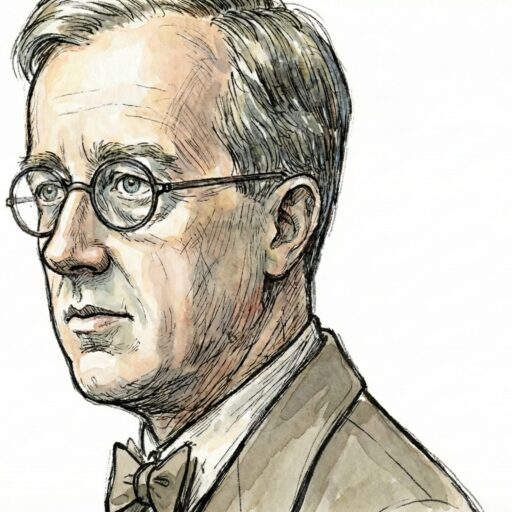

By 1916, the world was deeply troubled by the First World War. He had been rejected for military service due to his neuritis and bad eyesight, leaving him feeling isolated from the national effort (Jon C. Mitchell, A Comprehensive Biography, p. 134).
While the rest of the world was engulfed in the noise of modern warfare, Holst retreated to Thaxted. One evening, he entered the church at dusk and saw his pupil playing her violin while improvising a song. That combination of a single voice and a single instrument in a vast, empty space captured his imagination instantly.
Holst shared a fascination around medieval writings and ideals Holst with his friend Conrad Noel, who was the vicar of Thaxted. Holst selected the texts from Mary Segar’s A Mediaeval Anthology, a collection he had discovered during the war (Imogen Holst, The Music of Gustav Holst, p. 43). The poems date from the 15th century, connecting Holst back to his student days when he heard William Morris lecture on medieval art and comradeship.
It is indicative of the larger duality of Holst’s career / persona that these quiet austere songs were written almost simultaneously with the large textural Planets. Perhaps they represent an analysis to war just as much as Mars did. However, instead of depicting the brutality, they seek an “ideal,” unceasing silence and spiritual purity (Imogen Holst, p. 128).
Holst originally intended the singer and the violinist to be the same person. Technically, these songs are a bit groundbreaking because Holst abandoned time signatures entirely. He wanted the music to have the flexibility of speech or plainchant. As he explained later, he was searching for the true “musical idiom of the English language,” trying to make the tune “at one with the words” (Mitchell, p. 164).
The cycle consists of four settings:
- Jesu Sweet, now will I sing
- My soul has nought but fire and ice
- I sing of a maiden
- My Leman is so true
Bibliography
- Holst, Imogen. The Music of Gustav Holst. 3rd ed. Holst’s Music Reconsidered. Oxford: Oxford University Press, 1986.
- Mitchell, Jon C. A Comprehensive Biography of Composer Gustav Holst with Correspondence and Diary Excerpts.Lewiston, N.Y.: E. Mellen Press, 2001.